What is it about the humble potato that makes it so special?
Thanks go to Val on Plot 23 for suggesting this post and offering this info.
Just thought that some plotters might be interested to know that there is a new Scottish Seed Company, Seeds of Scotland, ( the only Scottish seed producer since the 1980’s). They are based in Evanton, Inverness and are selling only open pollinated seed ( no F1 hybrids) which either originate in Scotland or have been extensively grown here so evolved to grow in our climatic conditions. They have a limited but very interesting catalogue available now.
The benefits of making your own compost are well known. The best compost requires the right blend of green and brown materials added in layers. Making your own on your plot removes the need to cart weeds and the like off site for disposal.
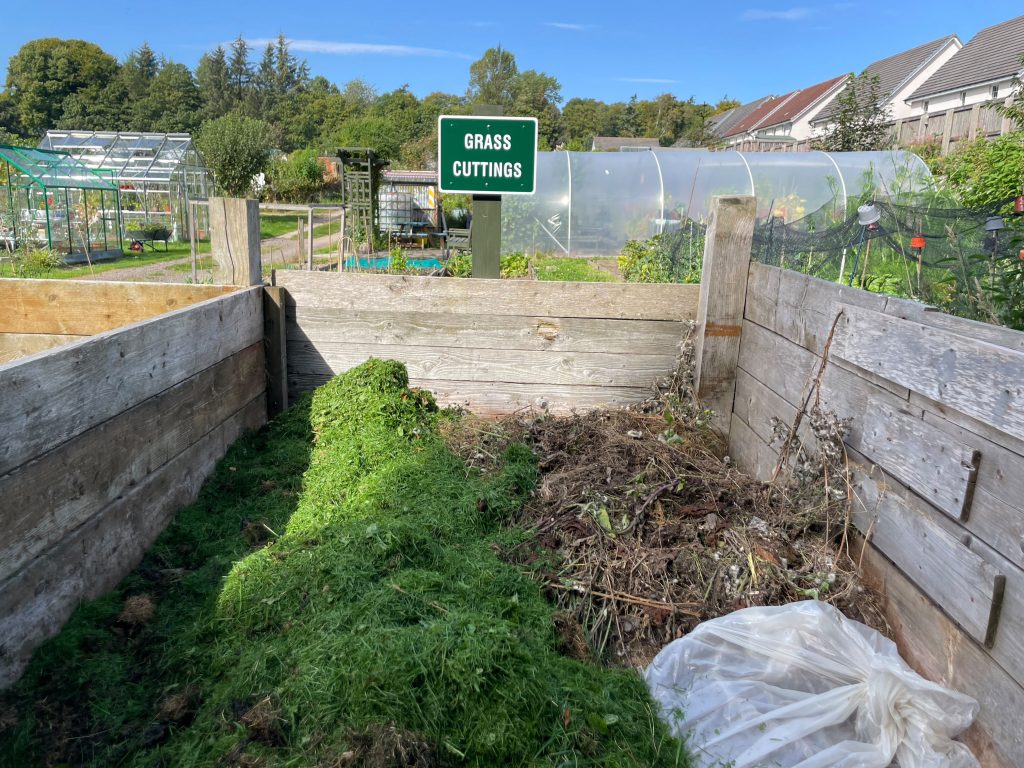
During the Summer we have on site plenty of free-to-all grass cuttings. These are to be found in a bin in the South-East corner of the site.
The materials in the white bags seen in the photo are coffee grounds. C-Fine deliver these grounds to us weekly. Many plotters consider coffee grounds to be a useful addition when compost making.
Please feel free to help yourself to these materials. There is nothing quite like grass cuttings to heat up and speed up your compost making.
The materials on the right side of the bin are seedy weeds dumped in the bin by a plotter. This is very disappointing. Plotters are best to compost their own weeds, or failing that, take them off site for disposal via their brown bins. They must not be dumped around the site or in communal bins.
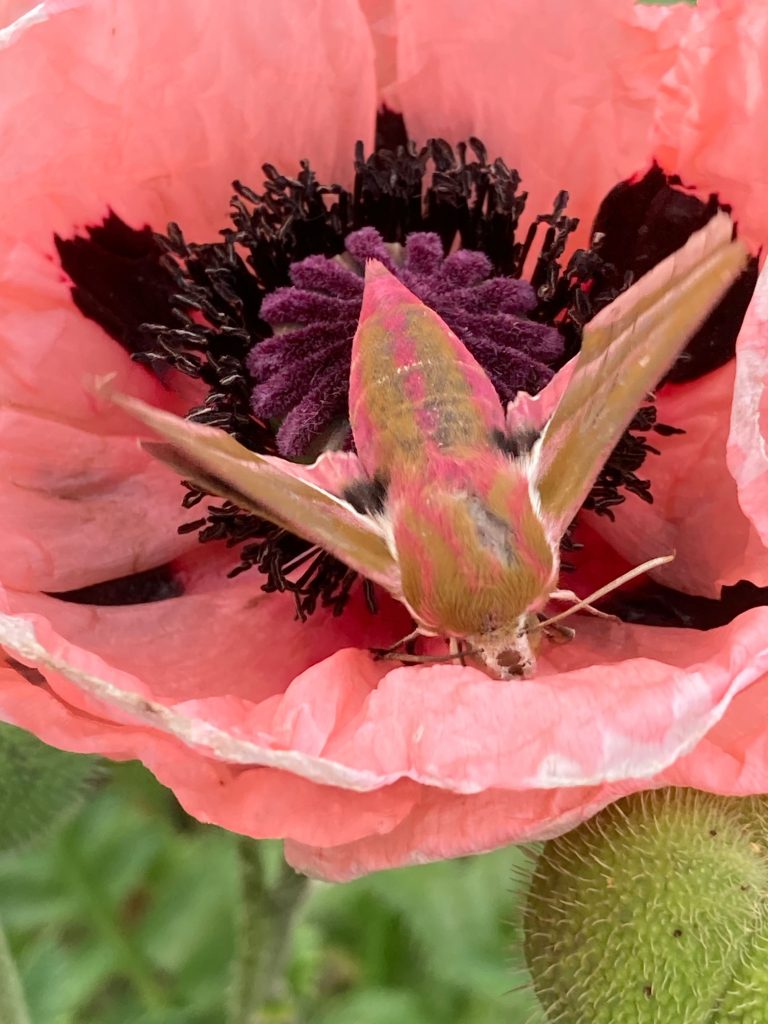
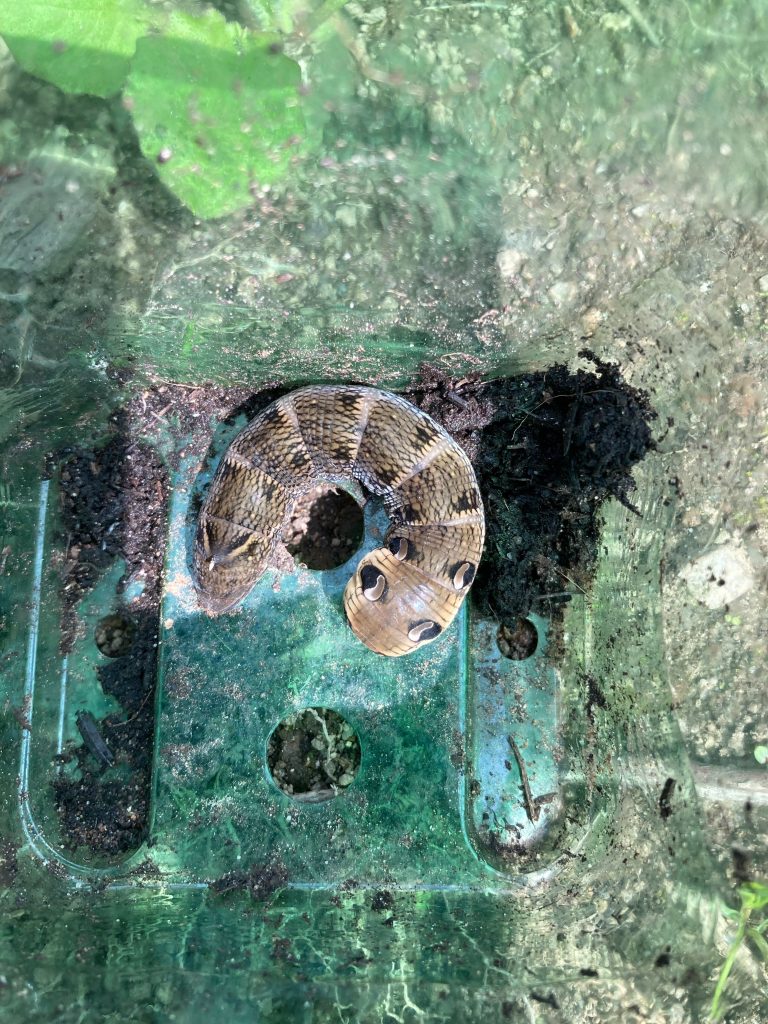
Anna (Plot 93) sent these photos of recent sightings on her plot of this Elephant Hawk Moth and caterpillar.
Photo Credit: Anna FulopPhoto Credit: Anna Fulop
I am aware of one other reported siting of an Elephant Hawk on site, but that goes back many years to 2017. I recall David (Plot 53) was the lucky host that time. (See the related post below.) If any plotter can provide info of other examples we’d love to hear from you.
It’s pleasing to think our efforts to green the site may be providing more habitats for unusual wildlife like the Elephant Hawk Moth.
Here’s what Chat GPT had to say about habitats attractive to them.
A Beginner’s Guide to the Lifecycle of the Elephant Hawk Moth and Its Preferred Habitat
The Elephant Hawk Moth (Deilephila elpenor) is a fascinating and visually striking insect found in various regions across Europe and parts of Asia. Its distinctive appearance, including its large size and vibrant colors, makes it a popular subject for nature enthusiasts and amateur entomologists. In this beginner’s guide, we will explore the lifecycle of the Elephant Hawk Moth and its preferred habitat.
1. Eggs:
The lifecycle of the Elephant Hawk Moth begins with the female laying her small, spherical eggs on the leaves of its host plants. These plants typically include willowherbs (Epilobium species) and bedstraws (Galium species). The eggs are pale green in color and are usually laid in clusters to increase the chances of survival.
2. Larvae (Caterpillars):
After about a week, the eggs hatch, giving rise to the larvae or caterpillar stage of the Elephant Hawk Moth’s lifecycle. The caterpillar is striking in appearance, sporting bright colors like lime green and having eye-catching eye-like markings on its head. It has a horn-like structure on its rear, which lends it the name “hornworm.”
3. Feeding and Growth:
The caterpillars are voracious eaters and immediately begin to feed on the leaves of their host plants. They undergo several stages of molting as they grow in size, shedding their old skin to accommodate their increasing body mass. The caterpillar stage lasts for about 4-5 weeks, during which they can grow up to 8-9 centimeters in length.
4. Pupation:
As the caterpillar reaches its full size, it undergoes pupation, which is the transformation into a pupa or chrysalis. The pupa is usually formed in a protected location away from direct predators and environmental hazards. The Elephant Hawk Moth pupa is reddish-brown and has a smooth texture, blending well with its surroundings.
5. Metamorphosis:
Inside the pupa, a miraculous transformation takes place. The caterpillar’s body undergoes significant changes, breaking down its tissues and reassembling them into the adult moth’s structures. This metamorphosis process generally lasts for about 2-3 weeks.
6. Adult Moth:
Finally, the adult Elephant Hawk Moth emerges from the pupa. At this stage, it becomes active at dusk and during the night, while resting during the day. The Elephant Hawk Moth is a large and impressive moth with a wingspan of about 5-7 centimeters. Its wings are predominantly pink or olive-green, providing excellent camouflage when resting on tree trunks or leaves.
Preferred Habitat:
The Elephant Hawk Moth can be found in a variety of habitats, but it tends to favor areas with plenty of nectar-rich flowers for adult feeding and suitable host plants for caterpillar development. Woodlands, hedgerows, gardens, and meadows are common places to encounter this magnificent moth.
1. Nectar Sources:
Adult Elephant Hawk Moths primarily feed on nectar from a range of flowers, including honeysuckle (Lonicera species), petunias (Petunia species), and jasmine (Jasminum species). Having a variety of these nectar-rich plants in the habitat will attract these moths.
2. Host Plants:
To encourage the presence of Elephant Hawk Moths, it’s crucial to provide suitable host plants for the caterpillars. As mentioned earlier, willowherbs (Epilobium species) and bedstraws (Galium species) are the preferred host plants. Allowing these plants to grow naturally in your garden or maintaining them in the wilder areas nearby can support the moth’s lifecycle.
3. Shelter and Water:
Creating a diverse habitat with vegetation of varying heights and densities will offer shelter to both caterpillars and adult moths. Additionally, a nearby water source like a pond or birdbath will provide the much-needed hydration for these creatures.
By understanding the lifecycle of the Elephant Hawk Moth and its preferred habitat, you can take simple steps to attract and support these beautiful insects in your environment. Whether you’re a nature enthusiast, gardener, or just curious about the natural world, observing these moths in their lifecycle can be a rewarding and educational experience.
We were all disappointed to find that our local supply of cow dung had dried up – so to speak! We are investigating alternatives which can be delivered in bigger tonnages – of domestic green waste compost and/or manure.
The scrapping of the containers from site produced a one-off windfall for GFAA funds and we hope to make around four barrowloads of dung and/or domestic green waste compost available free of charge to GFAA members.
We fear demand my outpace supply, so requests will be fulfilled on a first come, first served basis while supplies last.
If you are interested, please leave a comment below this post with your name and plot number. The compost/dung will be delivered to your plot once it is available. This may take a few weeks to organise. Bear with us.
If things work out and there is enough interest we may try to repeat this exercise.
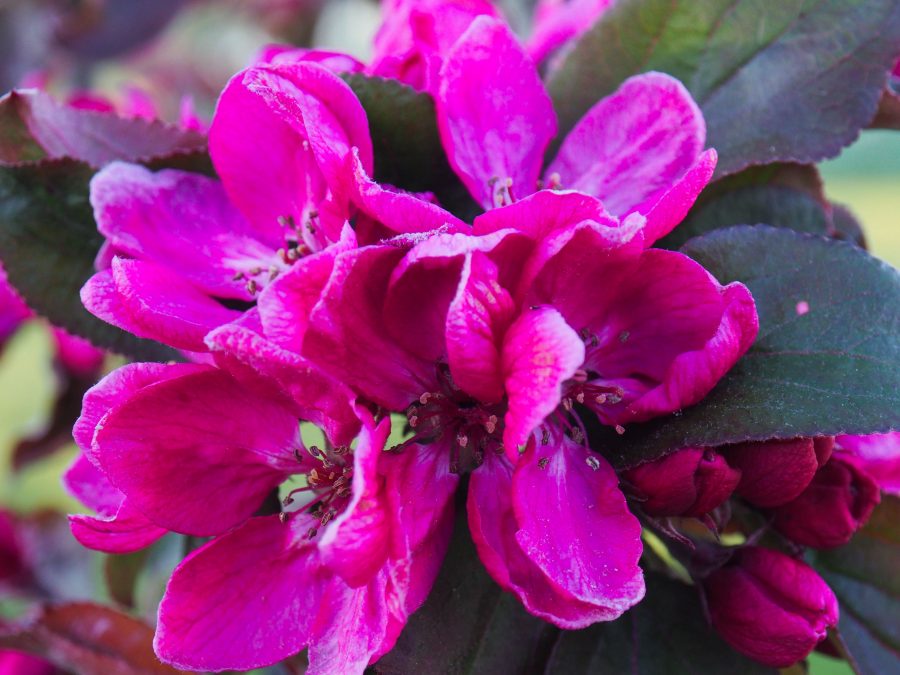
We are delighted to announce that GFAA’s application to the Scotmid Community Orchard scheme has been successful. We are to receive £200 for the purchase of fruit trees or bushes to extend out existing Community Orchard in the communal garden area on site.
Thanks go to Ron (Plot 65A) who wrote our bid and, of course, to Scotmid for offering their excellent Community Orchard Scheme.
We are tickled pink to be one of the early participants in the programme and have the chance to help add to the thousands of trees that will grow throughout local communities, from the north of England to the Highlands of Scotland – all thanks to Scotmid.
Plotters or volunteers who can offer advice, or help with purchase, planting or maintenance, please get back in touch. We would love to hear from you.
In the Fresh Food for Frugal Families Project, local primary pupils will work with volunteers to grow and cook their own vegetables, providing tasty, inexpensive, and healthy meals for themselves and their families. While they do so, they will develop thrifty habits and learn the importance of acting local to protect nature and the environment from Climate Change.
Together we will:
Experience the joys of working in teams outdoors in the fresh air
Grow and cook food to share with our families and local residents via TAMS
Learn how tasty, inexpensive and healthy home-grown food can be
Understand why locally grown food is better for our environment
explore practical ways of protecting the environment while cutting carbon
Learn to feed and conserve the soil to grow healthy disease-free vegetables
Create growing spaces safe for all sorts of bugs and beasties
Find out how green growing can cut emissions and protect against Climate Change
Recycle, repurpose and compost materials to cut down landfill waste.
How the funding will help
The Just Transition funding will allow us to enhance the experiences we offer our volunteers and school visitors by providing equipment to cut our carbon emissions and two outdoor learning spaces: a greenhouse laboratory and a solar powered workshop and classroom. These new spaces will also allow visits to go ahead in inclement weather.
Pupils will attend one afternoon a week over the full 10 week summer term. Our Volunteer Squad attends three times a week, 11 months of the year.